
Having cameras across a client site does not automatically create effective security oversight. A feed can be live, an alert can be triggered, and footage can be recorded, but someone still needs to assess what is happening, recognise activity that requires attention and make sure the right information reaches the right people when an incident occurs.
The scale of that responsibility is especially visible in retail environments. According to the Office for National Statistics, Crime in England and Wales: year ending March 2026, police recorded 507,086 shoplifting offences during the period. The ONS also notes that supporting evidence such as CCTV can strengthen reporting, intelligence and offender identification. Retail is one example, but the wider operational challenge applies across monitored environments: surveillance footage becomes more useful when security teams have a clear process for reviewing events and handling relevant information.
Operational standards reflect the same need. The UK Government’s Recommended Standards for the Surveillance Camera Industry, updated in May 2026, set standards for CCTV management, alarm signal processing, monitoring centres, and remote monitoring of detector-activated CCTV.
This article examines how live monitoring, alarm verification, structured incident response and camera health monitoring can help security providers maintain consistent oversight across client sites, distinguish genuine events from routine alerts and respond through clearly defined procedures.
How Does Live Video Monitoring Strengthen Security Oversight?
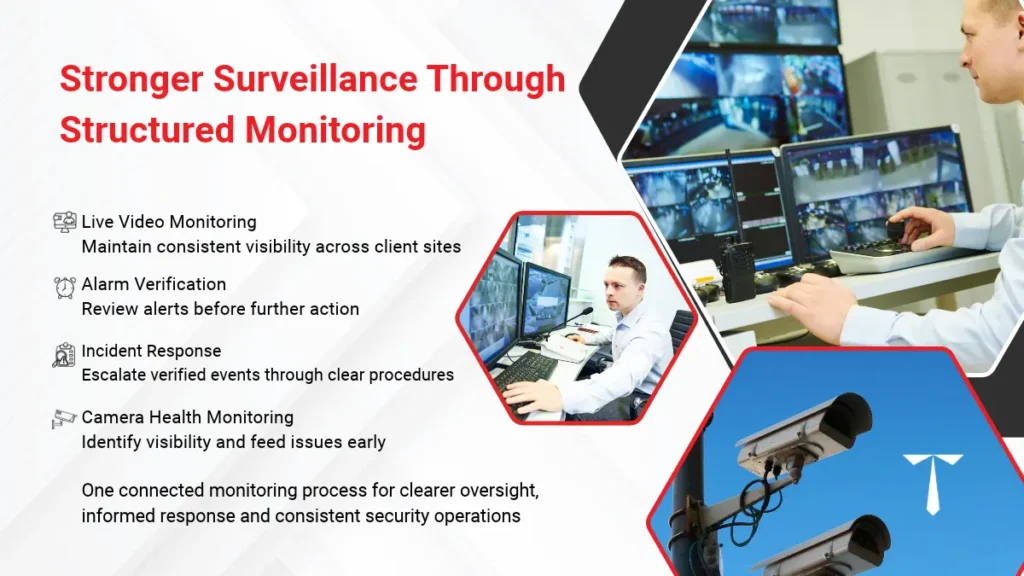
Security teams often manage several client sites, each with different layouts, access points, monitoring requirements and escalation instructions. Maintaining reliable oversight across those locations requires more than turning cameras on. It requires operators who understand what to look for and what should happen when activity needs attention.
Through remote CCTV monitoring, operators can review live camera feeds, assess unusual activity and follow predefined procedures when action may be required. The purpose is not to treat every movement as suspicious. It is to maintain consistent oversight and recognise activity that deserves closer review.
Key Operational Benefits
- Continuous site visibility: Operators can maintain oversight across multiple monitored locations without depending entirely on physical presence at each site.
- Focused observation: Unusual movement, restricted area activity or behaviour outside normal site patterns can be reviewed more closely to determine if further action is required.
- Clear escalation: When an event requires attention, operators can follow agreed procedures and pass relevant information to the appropriate security team or responder.
- Consistent monitoring processes: Site-specific instructions help operators handle events in a structured and repeatable manner while respecting the requirements of each client location.
Live monitoring is less about watching screens and more about knowing what requires attention, when to act, and who to inform. For security providers, that consistency can support a more organised monitoring operation across client sites.
Why Is Alarm Verification Important Before Escalation?
Not every alert represents a genuine security threat. Authorised staff, routine site activity, environmental movement or other expected events can trigger an alarm. Treating every alert with the same urgency can place unnecessary demands on monitoring and response teams.
Alarm verification creates an important assessment stage between receiving an alert and deciding what happens next. Within remote monitoring, operators can review the available camera footage, understand what triggered the alert and determine if the event requires further action.
The operational value comes from making that decision with context rather than reacting to a signal alone.
What Does Alarm Verification Support?
- Better alert assessment: Operators can review the activity behind an alarm before deciding how to handle it.
- Fewer unnecessary escalations: Operators can identify routine or non-threatening events before passing them to security teams or designated responders.
- Clearer incident information: Verified events can be escalated with relevant details about what was observed, where it occurred and what may require attention.
- More focused response: Security teams can direct attention towards incidents that genuinely require intervention rather than treating every trigger equally.
For security providers, alarm verification helps answer a simple but important operational question: Does this event require action? A structured assessment can make escalation more purposeful and give response teams clearer information when an incident is genuine.
What Makes Incident Response More Effective?
Once an event has been verified, the next challenge is making sure the right information reaches the right people clearly and promptly. A monitoring team may identify an incident correctly, but that value drops if the escalation process is unclear.
A structured security incident response process gives operators predefined steps for handling verified events. Those steps can include identifying the location, recording what has been observed, following site instructions and contacting the designated team or responder.
Three elements become particularly important.
- Defined responsibilities: Operators need to know who should be contacted for different types of incidents and what information should be shared.
- Relevant incident details: Location, time, observed activity and changes in the situation should be communicated clearly so the receiving team understands what requires attention.
- Consistent escalation procedures: Similar incidents should be handled according to agreed instructions rather than relying on individual judgement each time.
This structure becomes particularly valuable when security providers manage several clients with different escalation requirements. One location may require an internal security team to be contacted first, while another may follow a different chain of responsibility.
Effective incident response therefore depends on clear information, defined responsibilities and established escalation procedures. These elements help verified events move from observation to action in a more consistent and organised way.
Why Does Camera Health Monitoring Matter for Continuous Coverage?
A camera may appear to be part of an active surveillance system, but that does not always mean it is providing a reliable view. Connectivity issues, unstable feeds, poor image quality, obstruction or recording problems can reduce visibility without being immediately obvious to the wider security team.
Camera health monitoring helps identify these issues so they can be reported to the appropriate technical or site team. This supports more dependable security video surveillance by giving monitoring teams a clearer understanding of which cameras are functioning as expected and where coverage may be reduced.
What Can Camera Health Monitoring Help Identify?
- Feed availability issues: Operators can identify cameras that are offline, unstable or no longer providing a usable stream.
- Image quality problems: Blurred footage, poor visibility, obstruction or positioning issues can be flagged for attention.
- Recording concerns: Problems affecting recording or footage availability can be reported for further investigation where this falls within the agreed monitoring scope.
- Reduced site coverage: Monitoring teams can understand where visibility remains available and where a fault may be limiting oversight.
- Issues requiring technical attention: Identified concerns can be passed to the relevant technical or site team rather than remaining unnoticed during routine monitoring.
This can be particularly important for providers managing outdoor video surveillance, where environmental conditions, camera positioning and connectivity may affect the quality of the available view.
Camera health monitoring does not replace technical maintenance. Its operational value lies in identifying and reporting issues that may reduce visibility so the responsible team can investigate them. Reliable surveillance depends on knowing where coverage is working as expected and where attention is needed.
How Technomine Supports Remote Surveillance Operations
Security providers may already have cameras, monitoring procedures and response teams in place. The challenge is often maintaining consistent operational support across those elements, especially when several client locations require attention at the same time.
Technomine supports security providers through live video monitoring, alarm verification, incident response support and camera health monitoring. Trained operators work within predefined monitoring and escalation procedures, helping security teams maintain visibility across monitored sites and handle events according to agreed instructions.
The role is operational rather than hardware-focused. Technomine supports the processes behind the surveillance environment, helping ensure camera feeds are monitored, alerts are assessed, verified incidents are escalated, and visibility issues are reported to the appropriate teams.
For security businesses managing multiple client environments, this provides structured operational support around day-to-day surveillance requirements while allowing internal teams to concentrate on responsibilities that require direct intervention.
Build Stronger Surveillance Operations
Reliable surveillance requires more than cameras being installed across a site. It depends on consistent monitoring, verified alerts, defined escalation procedures and clear visibility across monitored locations.
Technomine supports security providers with live video monitoring, alarm verification, incident response support and camera health monitoring. Together, these services strengthen the operational support behind remote video surveillance cameras and help security teams maintain clearer processes for reviewing events, escalating genuine incidents and identifying camera issues.
Talk to Technomine about dependable monitoring support for your client sites and strengthen how alerts are reviewed, incidents are escalated and camera issues are identified.