
A provider may understand the task, but do they understand the industry behind it? For operations leaders managing regulated processes, demanding service standards, and sector-specific workflows, that distinction can directly influence how effectively outsourced work is delivered.
Industry knowledge matters because complex outsourced work depends on more than available resources. The 2025 study Digital Transformational Outsourcing: A Necessity Analysis of Service Provider Capabilities, published in IIMB Management Review, examined outsourcing service provider capabilities and found that different levels of provider capability can constrain performance in different ways. The research reinforces an important consideration for business leaders: provider capability matters when evaluating outsourced service delivery.
For organisations operating in healthcare, recruitment, security, finance, administration, and other process-intensive environments, specialised partners can bring greater familiarity with workflows, terminology, responsibilities, and service expectations.
This article examines how industry expertise can support workflow alignment, compliance, quality, process consistency, risk awareness, and specialised service delivery.
Why Industry Workflow Expertise Matters
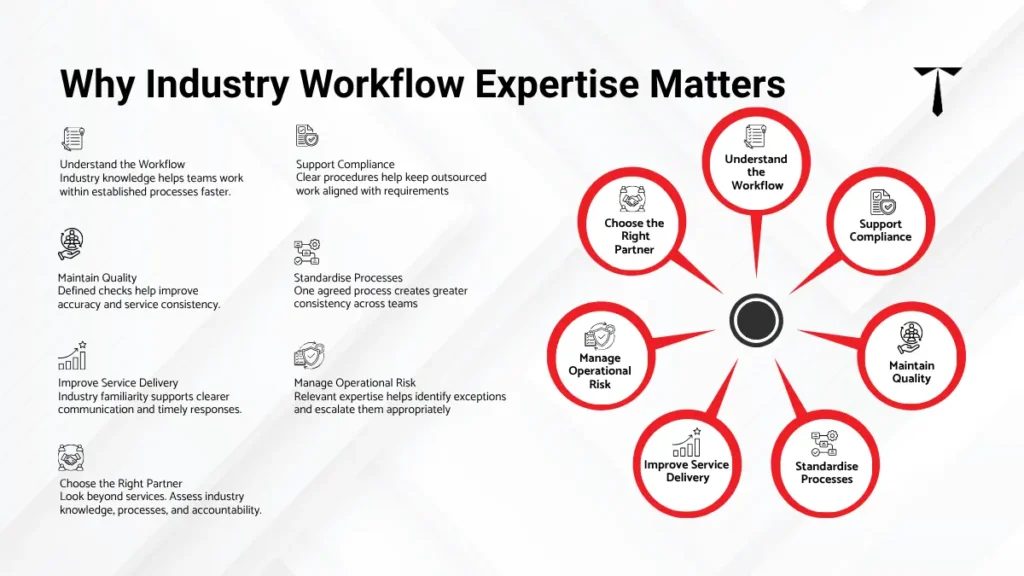
Knowing how to complete a task is different from understanding how that task fits into an industry. Healthcare, recruitment, security, finance, and administrative operations each have their own terminology, workflows, documentation requirements, and escalation procedures.
A specialised outsourcing partner familiar with these operating environments can require less familiarisation before working effectively within established processes.
Industry knowledge can help teams:
- Understand sector-specific workflows
- Handle terminology and documentation correctly
- Recognise dependencies between operational tasks
- Identify when an issue falls outside the normal workflow
For operations leaders, the advantage is practical: less time explaining how the industry works and more focus on getting the work done correctly.
Supporting Operations Compliance Through Process Knowledge
Compliance depends on people understanding the procedures, documentation, controls, and responsibilities attached to the work they perform. When an external team lacks this context, internal managers may need to spend additional time checking how requirements are being followed.
A specialised partner can support operations compliance by working within clearly defined procedures and understanding the requirements relevant to its responsibilities. This can include maintaining required documentation, applying agreed controls, and following established procedures when exceptions occur.
External expertise does not remove an organisation’s responsibility for compliance. Internal leadership must retain appropriate oversight and ensure that outsourced activities continue to meet applicable requirements.
Specialised support adds value when external teams can operate within established compliance requirements without creating unnecessary management intervention.
Building Consistency Through Operational Quality Control
Completing a process consistently does not automatically mean completing it correctly. Organisations also need a way to review outcomes, identify errors, and determine whether expected standards are being achieved.
Clear quality assurance processes can establish:
- Defined review checkpoints
- Measurable accuracy standards
- Regular performance checks
- Methods for identifying recurring errors
- Timely corrective action
This is where operational quality control becomes important. It gives operations leaders greater visibility into the accuracy and reliability of outsourced work rather than relying solely on task completion.
Standardisation defines how work should be performed. Quality control verifies whether the expected standard has been achieved.
Creating Repeatability Through Business Process Standardisation
When the same recurring task is completed differently across people, teams, or locations, variation can quickly become part of everyday operations.
Business process standardisation establishes an agreed way of completing routine work. It clarifies the sequence of activities, assigns responsibilities, and defines what information should be captured at each stage.
For organisations working with external teams, this creates an important operational baseline. Internal and outsourced resources can follow the same agreed process rather than developing separate ways of handling the same activity.
The result is greater repeatability, particularly when workloads increase or responsibilities are distributed across multiple teams.
Delivering Specialised Support That Fits the Business
Industry expertise becomes most valuable when it improves day-to-day service delivery. A specialised partner should understand expected turnaround times, communication requirements, priorities, and service expectations without requiring constant direction.
This can help organisations achieve:
- Faster responses to operational requirements
- Clearer communication between teams
- Appropriate handling of priorities
- Better understanding of service expectations
For COOs and operations leaders, the benefit is practical. Less time is spent correcting misunderstandings or explaining basic requirements, allowing internal managers to focus on decisions that genuinely require their attention.
Specialised service delivery should complement the way the organisation operates rather than create another layer for internal teams to manage.
Managing Operational Risk With Relevant Expertise
Industry experience can become particularly valuable when something falls outside the normal process. Experienced teams are better positioned to recognise exceptions, understand their responsibilities, and know when an issue needs internal attention.
Outsourcing is not a replacement for an organisation’s wider risk management solutions. It can, however, support stronger operational discipline when responsibilities and escalation requirements are clearly defined.
Business leaders remain responsible for determining acceptable controls and maintaining oversight of outsourced activities.
Choosing the Right Specialised Outsourcing Partner

Industry experience is important, but it should not determine the decision on its own. Business leaders also need to understand how effectively a provider can work within their processes, standards, and expectations.
Before selecting a partner, consider:
- Does the provider have relevant experience within your sector?
- Do they understand the operational requirements behind the work?
- Are responsibilities and escalation routes clearly defined?
- How will service quality and performance be reviewed?
- Can they work effectively within your existing controls?
The right partner should require less operational handholding while providing clear visibility into the work they manage.
Choose a partner that understands both the work and the business environment behind it.
Turning Industry Expertise Into Better Operations
Complex business operations need more than additional resources. They need people who understand the processes, standards, responsibilities, and service expectations behind the work.
The right Specialised Outsourcing Services can bring relevant industry knowledge into day-to-day operations while supporting accuracy, consistency, and clearly defined responsibilities. Strong outcomes still depend on choosing the right provider, setting clear expectations, and retaining appropriate internal oversight.
For business leaders, the decision should therefore focus on capability and operational fit rather than simply comparing providers on cost.
Looking for an outsourcing partner that understands more than the task? Connect with Technomine to discuss specialised support aligned with your industry, processes, and operational requirements.