
Operational Pressure Is Reshaping The Modern Outsourcing Strategy
Healthcare providers, legal teams, insurance companies, staffing firms, and operations leaders are under growing pressure to maintain turnaround times, reporting accuracy, compliance visibility, and operational continuity across increasingly fragmented workflows.
The challenge is no longer just workload. Delayed escalations, inconsistent follow-ups, manual coordination gaps, and unclear ownership continue creating rework cycles that slow operations and increase administrative risk.
According to the Centers for Medicare & Medicaid Services, administrative complexity remains one of the biggest operational burdens affecting healthcare organisations. Research published in JAMA Network also estimated that administrative costs account for a significant share of healthcare spending due to inefficient operational processes and coordination gaps.
This pressure is forcing organisations to rethink traditional outsourcing models built only around task completion. Businesses now expect structured outsourcing partnerships that improve accountability, reporting visibility, operational scalability, and measurable performance outcomes.
This blog examines how a stronger outsourcing strategy helps organisations reduce operational fragmentation, strengthen workflow control, improve turnaround consistency, and build operational stability across surveillance, recruitment, records retrieval, verification, and reporting functions.
Why Traditional Task-Based Outsourcing Models Create Operational Gaps
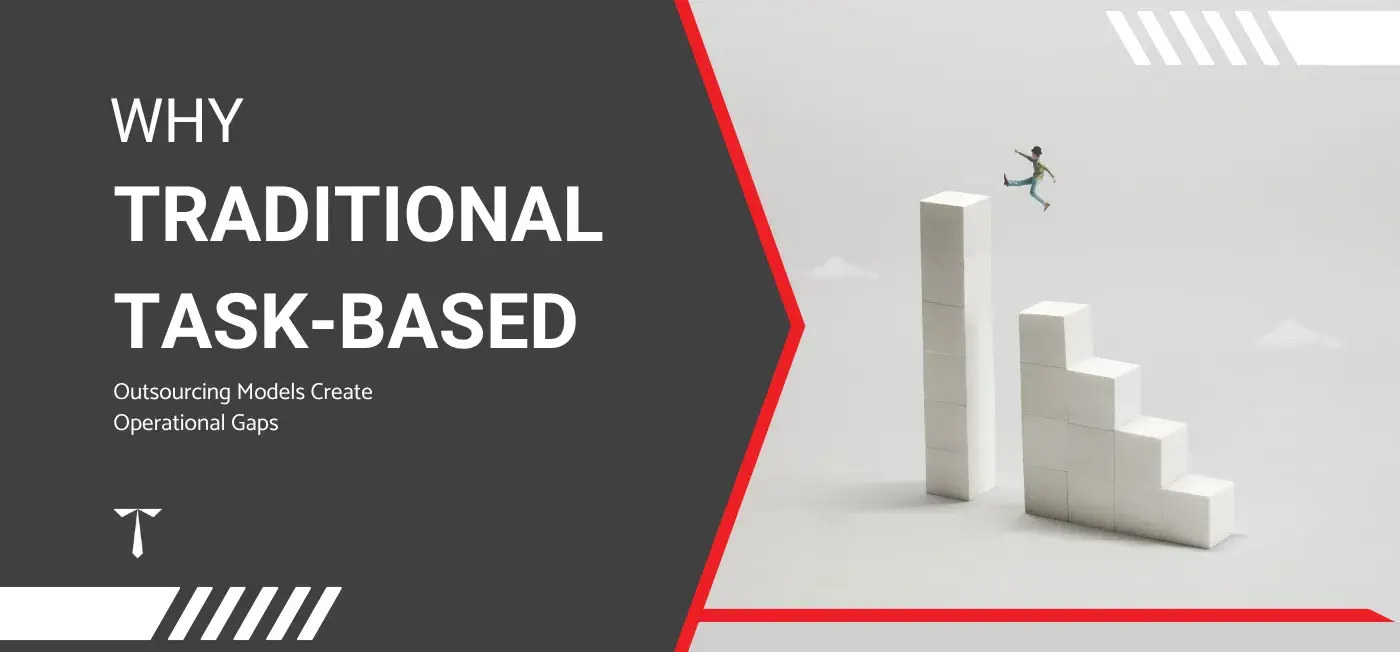
Many businesses still measure outsourcing success through completed tasks, ticket volumes, or short-term outsourcing cost savings. The problem starts when operational pressure increases. Internal teams begin spending more time coordinating work than actually moving operations forward.
Inside healthcare administration and records retrieval departments, delayed follow-ups and incomplete documentation often slow retrieval timelines. Legal and litigation support teams regularly face bottlenecks during verification, indexing, and case file coordination. Insurance processing departments struggle when requests move across multiple teams without clear ownership or reporting visibility. In surveillance monitoring departments, delayed escalation handling can weaken operational response during active incidents.
This is where the discussion around outsourcing vs in-house operations becomes operational, not just financial. Internal teams may keep direct oversight, but fragmented workflows often create delays once workloads scale across departments.
A structured outsourcing model works differently. Departments handling healthcare recruitment, records retrieval, verification processing, digital marketing reporting, and video surveillance operations benefit from clearer accountability, escalation control, and structured execution support. For operations leaders, the objective is not simply to reduce workload. It is maintaining consistent operational control under pressure.
Stronger Escalation Control Improves Video Surveillance Operations
Video surveillance operations often slow down after an alert is detected, not during monitoring itself. Large facilities generate continuous alerts across shifts, locations, and departments. Without clear escalation control, response coordination becomes inconsistent.
Many monitoring teams face the same issue. Alerts enter the queue, but ownership remains unclear between operators, supervisors, and response teams. Some incidents move quickly, while others remain pending longer than they should. This weakens response consistency across operations.
The pressure becomes higher inside warehouses, healthcare campuses, logistics hubs, manufacturing sites, and commercial facilities where monitoring teams manage ongoing operational activity throughout the day.
Structured video surveillance operations improve response management by creating:
- defined escalation of ownership
- organised verification pathways
- faster incident prioritisation
- clearer reporting visibility
This also strengthens outsourcing sla performance because response timelines become easier to measure and track. Operations leaders gain better incident visibility, improved escalation tracking, and stronger vendor performance management across surveillance departments.
Why Structured Retrieval Operations Improve Turnaround Consistency
Retrieval delays usually begin when document requests move across multiple departments without clear coordination. In healthcare administration teams, patient records often remain pending between facilities, approvals, and processing queues. Legal support departments face delays when case files arrive incomplete or verification stages remain unresolved. Insurance operations experience similar pressure when claims processing depends on records arriving within strict timelines.
As workloads increase, internal teams spend more time resolving status gaps, correcting incomplete submissions, and managing disconnected communication across departments. Delays gradually build across the workflow.
Structured records retrieval services help reduce this pressure through organised tracking, defined processing stages, and clearer request ownership.
Stronger support for retrieval operations:
- faster request handling
- clearer document visibility
- reduced processing delays
- stronger verification accuracy
This also improves outsourcing reporting by giving operations leaders better visibility into pending requests, retrieval timelines, and workflow bottlenecks. Over time, organisations gain more reliable BPO performance metrics across healthcare, legal, insurance, and verification departments.
Scalable Hiring Pipelines Improve Workforce Continuity

Recruitment departments across healthcare providers, staffing firms, and verification companies are under pressure to maintain workforce continuity while handling rising placement demands. The issue is not always candidate availability. The real challenge is maintaining hiring consistency when workloads increase across departments and locations.
Many organisations still operate through reactive hiring cycles. Vacancies open, placements get rushed, onboarding slows, and workforce gaps continue to repeat. This affects scheduling, compliance coordination, background verification, and service delivery operations.
Healthcare providers experience this heavily during workforce shortages, where delayed hiring affects operational coverage and patient administration. Staffing and verification firms face similar pressure when hiring pipelines lack structure.
Structured healthcare recruitment services improve workforce continuity through:
• scalable hiring support
• organised placement coordination
• structured onboarding processes
• clearer recruitment accountability
This also strengthens vendor performance management through better placement visibility, retention tracking, and hiring consistency. Over time, organisations achieve stronger outsourcing cost savings by reducing repeated hiring pressure and operational disruption.
Operational Visibility Strengthens Decision Making Across Departments

Operations leaders rarely struggle because data is missing. The real issue is fragmented reporting across departments, systems, and teams. Recruitment teams maintain separate hiring updates, retrieval departments track requests independently, and surveillance operations manage separate incident logs. Leadership teams then spend time combining disconnected updates into usable decisions.
This weakens operational visibility. Pending workloads increase, escalation queues grow, and performance gaps remain unnoticed until service levels begin slipping.
Inside healthcare administration, legal processing, insurance coordination, and verification departments, disconnected reporting structures make operational slowdowns harder to identify and manage.
Structured operational support improves visibility through:
• centralised reporting accountability
• clearer turnaround tracking
• better workload visibility
• organised operational updates
Departments managing digital marketing services, retrieval operations, surveillance monitoring, and recruitment coordination benefit from more consistent reporting structures that support faster operational decisions.
This also strengthens outsourcing reporting and improves measurable outsourcing kpi’s and reliable BPO performance metrics across operational workflows.
Operational Governance Reduces Workflow Instability

Many organisations already outsource operational functions, but results depend on how responsibilities, reporting, and execution are managed. Weak delivery frameworks create ownership confusion, inconsistent turnaround handling, reporting gaps, and additional coordination pressure for internal teams.
Departments managing surveillance monitoring, records retrieval, recruitment coordination, verification processing, and reporting operations perform more consistently when execution pathways remain clearly defined across every stage.
A stronger outsourcing strategy focuses on:
• measurable service accountability
• clear escalation ownership
• organised reporting visibility
• scalable operational coverage
• consistent turnaround management
This is where reliable outsourcing sla frameworks become operationally critical. Clearly defined service expectations help organisations maintain execution consistency across departments during high-pressure periods.
The discussion around outsourcing vs in house operations is no longer limited to staffing costs alone. Organisations now prioritise workflow control, reporting visibility, and execution reliability when managing critical functions through outsourcing partnerships.
Measurable Control Starts With Operational Accountability
Operational pressure rarely begins with a single failure. Delays usually build up across disconnected workflows, unresolved escalations, reporting gaps, workforce instability, and rising coordination pressure between departments.
Healthcare providers, legal operations teams, insurance companies, staffing firms, and verification organisations all face the same challenge. Internal teams are expected to maintain faster turnaround times, stronger compliance visibility, and stable operational performance while workloads continue increasing.
This is why outsourcing partnerships are becoming more operationally important in 2026. Organisations are no longer evaluating providers only through completed tasks or staffing capacity. The focus has shifted toward measurable operational control, reporting accountability, scalability readiness, and execution consistency.
A strong outsourcing model supports operations through:
• clearer workflow ownership
• faster escalation handling
• measurable reporting visibility
• scalable workforce coordination
• stronger operational continuity
For operations leaders, the priority is maintaining operational control without increasing internal coordination pressure.
Organisations that build mature operational partnerships gain better visibility, stronger turnaround consistency, and more reliable execution across surveillance, recruitment, retrieval, verification, and reporting departments.
Explore how Technomine supports operational workflows through accountable execution, scalable support, and performance-driven operational management.