Operational delays in compliance-heavy environments are not driven by workload, but by inefficiencies within the process.
Across healthcare providers, legal teams, insurance companies, and verification firms, work slows between stages where ownership is unclear and visibility drops. Tasks expected to move within a 24 to 48-hour window are delayed by multi-day gaps due to workflow inefficiencies embedded in the system.
The Centres for Medicare & Medicaid Services defines administrative burden as complex and redundant processes that directly delay care delivery and operational execution.
At the system level, U.S. healthcare spending reached $5.3 trillion in 2024, with administrative complexity remaining a significant contributor to cost and delay across operations.
This pattern extends across every compliance workflow. Legal and insurance operations slow between approvals and documentation checks. Verification and staffing workflows stall between validation and reporting. Work does not stop due to volume. It stops when the process loses control.
This article breaks down where delays begin, the impact they create, and how workflow optimization built on clear ownership and structured execution restores speed and reliability.
Where Monitoring Gaps Create Operational Delays
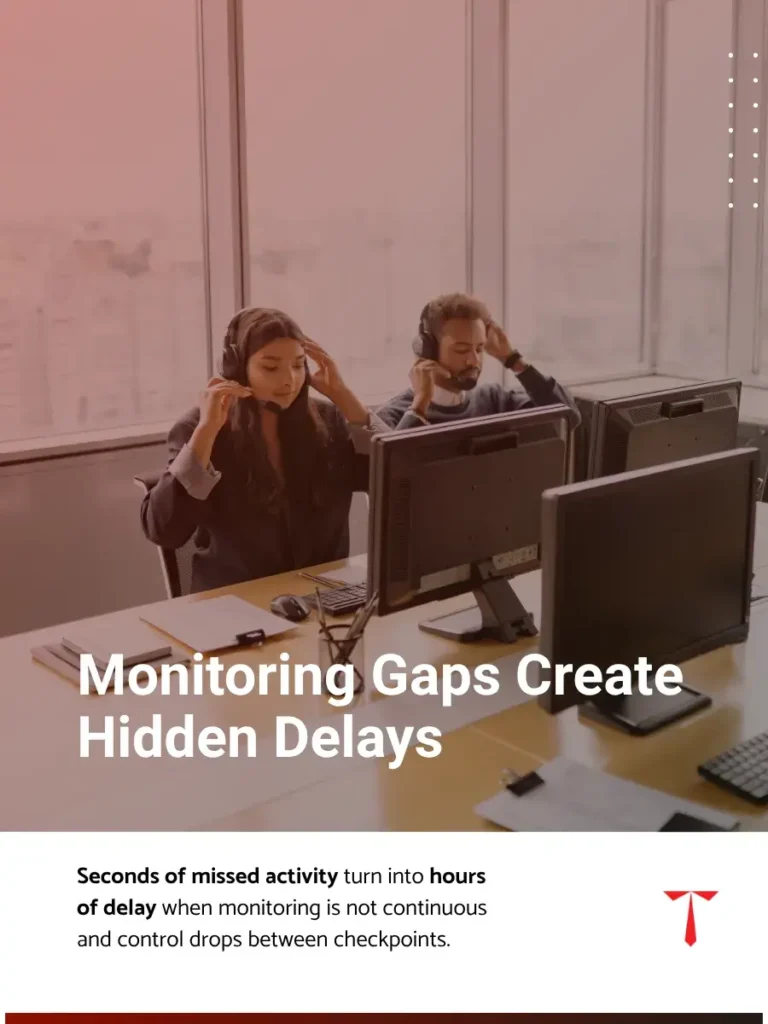
Most monitoring setups fail quietly.
Screens stay active. Systems look stable. Teams assume everything is under control. In reality, feeds go inactive, alerts get missed, and no one notices until something escalates. The delay does not start at the incident level. It starts earlier, when activity is not actively tracked.
This gap is common in video surveillance operations, where monitoring is treated as periodic checks rather than continuous control.
Alerts sit in queues longer than expected. Shift handovers miss unresolved activity. Teams rely on logs instead of live tracking. Without a structured workflow checklist, responses become inconsistent and dependent on individual follow-ups.
The issue is not visibility at the reporting level. It is controlled at the execution level.
Teams that stay consistent track movement continuously, not just outcomes. Every feed, alert, and queue is actively monitored. Inactivity is flagged immediately. Escalations follow defined timelines. Ownership is clear, so nothing sits unattended.
This is where workflow optimization starts showing measurable impact.
Record Movement Delays That Slow Down Decisions
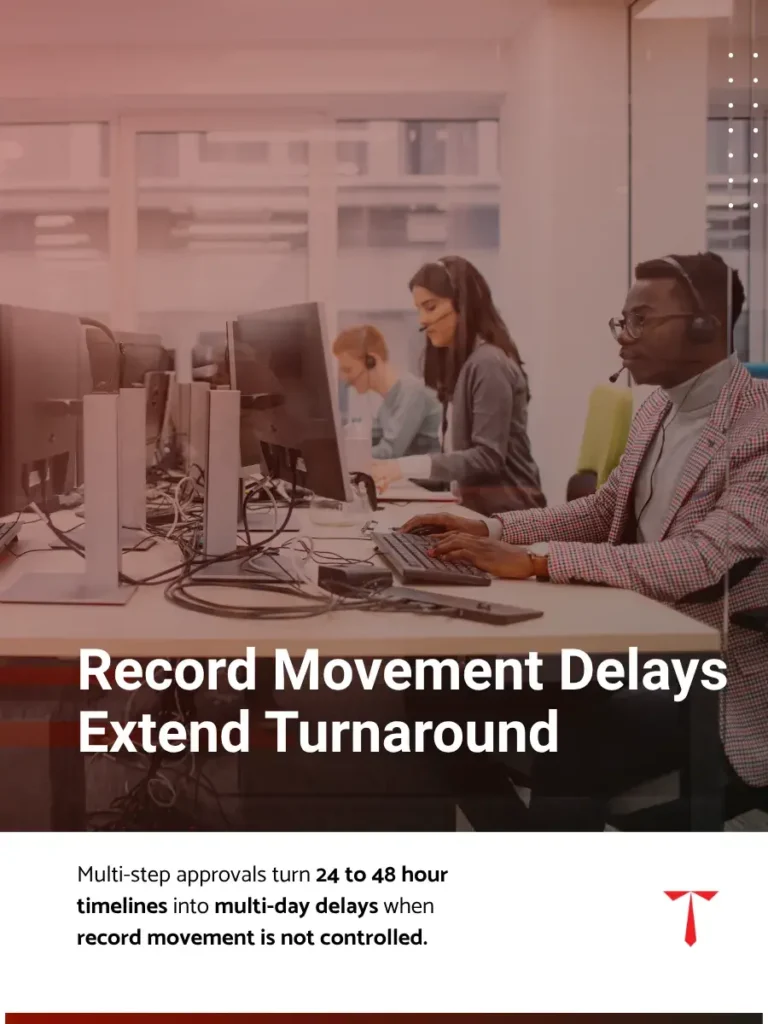
Record delays do not start at the request. They begin once the file starts moving.
In healthcare providers, legal teams, and insurance operations, the medical records retrieval process slows down at each step. Verification waits for confirmation. Approvals sit in queues. Follow-ups depend on emails. Ownership shifts across teams without clear control.
That is where timelines begin to slip.
This becomes visible very quickly in records retrieval workflows. Records move, then pause. Teams spend time chasing status instead of moving files forward. There is no clear view of where a record stands at any point. Even established medical record retrieval services face delays when coordination is not tightly managed.
This is a documentation workflow breakdown.
When each stage operates in isolation, small delays compound. One missed follow-up delays the next step. One pending approval blocks the entire chain. The process slows without anyone clearly owning the delay.
This is why many record retrieval companies struggle to maintain consistent turnaround. The issue is not capacity. It is control over movement.
Teams that stay consistent remove this gap early. Every file has defined ownership at each stage. Movement is tracked continuously, not reviewed later. A structured approval process workflow ensures records do not sit waiting for manual intervention.
This is where workflow optimization becomes measurable.
Hiring Delays That Slow Down Workforce Readiness

Hiring delays rarely start with a talent shortage. They start inside the process.
In staffing firms and recruitment environments, especially across healthcare recruitment, the slowdown happens between stages. Screening is completed, but feedback is delayed. Approvals sit in queues. Decisions depend on multiple stakeholders, but ownership is not clearly defined.
You see this in how candidates move through the pipeline. They progress, then pause. Teams rely on manual follow-ups to move profiles forward. There is no clear view of where a candidate stands at any point.
This is a compliance workflow issue.
When hiring is managed as a series of disconnected steps, delays compound. One delayed response blocks the next stage. One unclear ownership point slows the entire decision cycle. The result is extended hiring timelines and increased candidate drop-off.
Operations that maintain speed remove these gaps early.
Each stage has defined ownership. Movement is tracked continuously. A clear workflow document approval structure ensures decisions do not sit waiting. Teams operate with a structured workflow checklist, so candidates move without dependency breaks.
That is where workflow optimisation shows up in actual turnaround, not just planning.
Fragmented Workflows Across Healthcare, Legal, and Insurance

Most delays in healthcare, legal, and insurance operations do not come from one team slowing down. They come from how work moves across teams.
In healthcare and insurance workflows, work moves across multiple systems that do not align. Documentation is reviewed again because processes are not connected. Approvals repeat because there is no shared control.
This kind of fragmentation is common in large-scale operational setups where multiple service lines operate independently without a unified structure.
You see it in duplicated checks, repeated validations, and gaps between systems. A case progresses, then pauses because the next team does not have full context. That pause is rarely tracked. It just becomes part of the delay.
This is not about team efficiency. It is about their coordination.
In a fragmented compliance workflow, every handoff becomes a risk point. The more checkpoints added for control, the more the process depends on alignment. Without that alignment, rework increases and timelines extend without clear ownership of the delay.
Operations that stay consistent remove that duplication early.
Information moves once and is accepted at each stage. A single documentation workflow is followed across teams, so the same file is not revalidated at every checkpoint. Movement stays continuous because the process is aligned end to end.
That is where workflow optimization starts to show up in actual timelines, not just internal reporting.
Conversion Loss Starts Inside the Funnel

In many digital marketing and sales operations setups, the problem starts after the lead enters the system. A lead comes in with intent, then slows down between stages. Responses are delayed, ownership is unclear, and follow-ups are inconsistent.
This is where deals start slipping.
In many teams, the funnel appears full but is not moving. Leads are sitting in different stages without clear action. Marketing has done its part. Sales is waiting for context. Operations are not aligned with timelines. No one owns the delay, but the delay is there.
You can see it in small signals.
Follow-ups are uneven. Responses depend on individual effort. Some leads move fast, others sit without reason. That inconsistency is not random. It comes from how the process is set up.
When the funnel is treated as a set of tasks, movement depends on people. When it is treated as a flow, movement depends on structure.
Strong teams remove that gap early. They define what happens the moment a lead enters. Who responds, how fast, and what comes next. A clear workflow document approval path ensures decisions do not sit waiting. A working workflow checklist keeps every stage active without relying on memory or manual follow-ups.
That is where workflow optimisation connects directly to outcomes.
Execution Gaps Are Slowing Your Operations
Delays across healthcare, legal, insurance, and verification operations are not caused by volume. They come from gaps in ownership, visibility, and control between stages. Work moves, then pauses. Teams follow up instead of executing. That is where time, cost, and risk increase.
Strong operations do not manage delays. They prevent them by controlling movement at every step. That is where workflow optimisation delivers real impact.
If your workflows are slowing down between stages, the issue is in the process, not the workload. Connect with Technomine to bring that movement back under control.